
How to become the master of yourself
Free will or invisible programming? Series, part 10.
Across this series you have been learning to see. The childhood roles that placed you before you could choose. The limits of language that gave your thoughts their shape. The different versions of you that people and situations call forward. The halves pushed into shadow. The patterns you repeat. The small space between trigger and reaction. The environment that quietly shapes you each day. And the invisible forces a person turns to when the visible world alone does not give enough answers.
Maybe, at the end of this journey, a strange feeling has caught you. The more programs you see in yourself, the more it can seem that you are more trapped than when you began. As if someone had shown you all the threads that move you, and now it is harder to pretend they are not there.
That feeling is understandable. And at the same time, something quite the opposite is actually happening.
You can never build a relationship with what you cannot see. An invisible program runs you blind. You cannot speak with it, you cannot question it, you cannot choose something else beside it. It simply runs.
The moment you see the program, something shifts. Not because seeing makes you instantly free, but because seeing is the first place where freedom becomes possible at all. What you can see no longer drives you in total darkness. What you can name no longer holds the same quiet power over you.
All those threads you now notice are not a sign that you are more trapped. They are a sign that you have begun to wake up. And mastery begins with waking up.
So what is mastery, really? Here it is worth setting one common idea aside at once.
The master of themselves is not a person with no programs left. No such person exists. The master of themselves is not someone who has reached total control, never falls back into an old reaction, stays forever calm and never errs. That is not mastery. It is just a new dream of perfection that leaves you judging yourself against the next yardstick.
Think instead of a real master of a craft. An old carpenter is not someone who no longer feels the resistance of the wood. The opposite. They feel it better than anyone. They know where the wood bends, where it breaks, where the knot sits, and which way the material wants to move. They do not fight the wood. They work with it, because they know it so deeply.
The master of themselves is the same. They are not someone who has got rid of their patterns. They are someone who knows them so well that they no longer let themselves be dragged along blind. They see the trigger coming. They recognise the old reaction while it is only beginning to rise. They notice when the child is speaking inside them, when the defence, when the fear, when the old role, and when the deeper knowing. And it is exactly this knowing that gives them room to choose.
Let us gather, for a moment, everything we walked through in this series. Mastery is not one trick. It is not one breathing technique, one test, one ritual, one big decision. It is many small acts of seeing coming together.
In the first article we saw that free will is not something you are born with. It is a capacity that can be developed. In the second and third we looked at how childhood and language set your thoughts on certain tracks before you had a word to say. In the fourth we saw that you are not one rigid self, but many versions that different situations call forward. In the fifth we learned that what you suppress in yourself does not vanish, but steers you from the shadow. In the sixth we saw how we repeat the very thing we hated. In the seventh we found the small space between trigger and reaction where choice is truly born. In the eighth we looked at the environment that either supports that space or tears it down. In the ninth we asked why we seek meaning in invisible forces, and came closer to seeing that a person always lives in the visible and the invisible world at once.
Each article was a piece. Mastery is what happens when the pieces begin to work together. You see the pattern, recognise its root, notice the small space, use the body as an anchor, shape the environment, hold the power of words more consciously, and give your journey a meaning larger than mere self-control.
Here is the core of this article, and of the whole series.
You are programmed before you are free. And the moment you learn to see the program, freedom becomes possible.
The master of themselves is not the one who is free of programs. They are the one who has a relationship with them. Who is no longer the slave of their patterns, but slowly their guide. Not with an iron hand, but the way a master knows their material: with respect, with patience, and with the knowledge that the work never quite comes to an end.
Mastery is not a destination you reach one day and then rest. It is a direction. A way of moving. Every time you notice your pattern and take a single breath before you react, you are a master in that moment. In the next moment you may slip again. That does not cancel the earlier win. It is simply the natural rhythm of the work.
Inner freedom does not grow in a straight line. It grows in repetitions. In moments of noticing. In returns. In the small instants where the old road was already open, and you stepped aside for a moment.
There is one more layer worth naming, because without it mastery stays only a technique.
The part of you that can watch your own programs from the side is something more than the program itself. When you notice your reaction, who is it that notices? When you recognise the old pattern, what in you is the one that recognises? When you see fear, shame, anger or defence rising in you, what is that quiet place from which you see it?
In that watching part, in that inner witness, lives something that cannot be reduced to the mere sum of childhood, language, environment and nervous system. You do not have to explain it fully in order to trust it. Some call it awareness. Some the deeper self. Some the soul. Some a quiet presence. The words may differ, the experience is familiar to many: in you there is a place that sees, even when everything else in you is reacting.
It is exactly here that the visible and the invisible meet in you. On one side are the real patterns, which can be watched, understood and re-learned. On the other side is that quiet presence which sees them, and which cannot be fully explained through patterns alone. Becoming the master of yourself is not only re-teaching your behaviour. It is also, slowly, coming home to the one you are underneath it all.
What this doesn't mean
It does not mean you have to become perfect. A master is not someone who never falls again. A master is someone who knows how to fall and rise again, without letting every fall turn into proof of their worthlessness. The old pattern will come back. Especially when you are tired, afraid, cornered, or in an environment that calls it up again. That is not failure. That is being human. Mastery is not the absence of falling. It is how quickly and how gently you return to yourself.
It also does not mean you must take on all this work at once. Nine earlier articles are a lot. If you try to live them all at the same time, you will burn out and give up. Choose one thing. Only one. One pattern to begin noticing. One reaction you bring a breath in front of. One environment you change a little. One word you start using differently about yourself. The rest will wait. It is not going anywhere.
It does not mean you are now somehow above the people who do not yet see their programs. That would simply be the old superiority in a new coat. Everyone is programmed, you included. A master is not someone who stands over others. A master is someone who knows they are the same kind of human, and treats others with that knowledge.
And it does not mean mastery is only the work of the visible world. The body, the nervous system, habits and environment matter. At the same time there is meaning, energy, symbol, soul and an invisible inner space in a person. Mastery does not choose between them. It learns to hold them together.
A small exercise
This series has been long. Instead of giving you one more new task, I will ask you to do something simpler.
Think back over everything we have looked at together, and ask: which one thing stayed with me most? Not the cleverest or the most correct thing. Just the one that genuinely touched you. Maybe it was a childhood role. Maybe the language you limit yourself with. Maybe a half you pushed into shadow. Maybe an old chain you have not tested in a long time. Maybe that small space inside a single breath. Maybe the thought that your words, your state and your intention carry more weight than you have believed.
Choose that one thing. And promise yourself that over the next week you will simply notice it a little more. Not change it. Not fix it. Not turn it into a new self-improvement project. Only notice.
Because all mastery begins where this series began: with seeing. Everything else, choice, change, freedom and growth, grows out of that one skill. And you do not build that skill with one great effort. You build it one small act of noticing at a time.
Be gentle about it. Do not go to the most painful place. Choose something that is within your reach right now, and stay with it calmly. Mastery does not need force. It needs steady presence.
This was the last, the tenth article of "Free will or invisible programming?". We began with the question of whether we have free will at all. We end with the knowledge that free will is not a thing you either get as a birthday gift or do not. It is a skill. And like any skill, it grows through seeing, repetition and patience.
You do not have to sum up this series today or remember all of it. Just notice that you look at yourself a little differently than ten articles ago. That shift may be small. Very small. And it is exactly out of that small shift that the whole work is made.
You are no longer only the one who reacts. In you there is also the one who notices the reaction. And as that part of you grows, your whole life changes.
Becoming the master of yourself is one of the deepest journeys of growth a person can take. It is never quite finished, and it is hard to walk alone. The hardest thing is to see the very patterns you were born inside. They feel so natural that you do not notice them at all. Here another person helps, someone who sees you more clearly than you can see yourself from within, and who walks beside you without handing down ready answers from above.
There is a moon in the name Evoluna. Luna. The moon does not make its own light. It reflects. It shows both the bright side and the dark, calling neither one a sickness. That is exactly how we want to see a person. As a whole, whose visible and invisible halves belong together. Body and soul. Nervous system and meaning. Science and inner experience. Pattern and mystery.
Evoluna is a place where your real patterns and your deeper meaning can meet, with clarity, openness and respect. A bridge between the specialist and the seeker. And at the same time a bridge between the visible and the invisible, between science and inner sensing, between studied knowledge and a person's deeper experience.
This is what we are building at Evoluna. A place where you do not have to go on alone.
You were programmed before you were free. And now, as you learn to see the program, freedom is possible. The rest is the journey. Your journey, at your own rhythm.
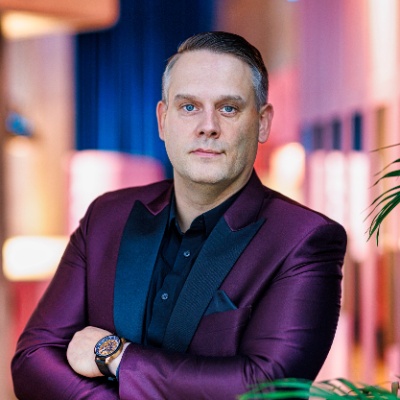
Pert Lomp is the founder of Evoluna and an EMCC-certified mentor.
Kuidas see artikkel sind puudutab?
Kommentaarid
Pert Lomp
Strateegiline mentor ja süsteemide looja
Olen strateegiline mõtleja ja süsteemide looja, kes aitab inimestel ja organisatsioonidel liikuda kaosest selguse, struktuuri ja tulemuste suunas. Minu tugevus seisneb võimes näha suurt pilti ning siduda omavahel tehnoloogia, finantsid ja juhtimine tervikuks, mis päriselt töötab. Mul on üle 25 aasta kogemust erinevates rollides – alates tehnoloogia ja meedia valdkonnast kuni juhtimise, äriarenduse ja strateegilise nõustamiseni. Tegutsen täna eelkõige mentorina ja partnerina inimestele, kes on jõudnud punkti, kus järgmine samm ei vaja enam rohkem infot, vaid selgust, otsust ja suunda. Mind käivitab kasv – nii inimeste kui süsteemide tasandil. Usun, et enamik piiranguid ei tule väljastpoolt, vaid meie enda mõtteviisist, harjumustest ja uskumustest. Minu roll on aidata need mustrid nähtavaks teha, need lahti murda ning asendada need toimivate, teadlike valikutega. Minu lähenemine on kombinatsioon ratsionaalsest strateegiast ja sügavamast inimlikust mõistmisest. Töötan seal, kus kohtuvad loogika ja sisemine areng – kus otsused ei ole ainult õiged Excelis, vaid ka kooskõlas inimese tegeliku potentsiaali ja suunaga. Mentorina olen otsekohene, kohal ja tulemustele suunatud. Ma ei paku pehmendatud vastuseid, vaid selgust. Samas loon ruumi, kus inimene saab turvaliselt mõelda, näha ja kasvada. Minu jaoks on kõige suurem väärtus hetk, kus inimese sees tekib “klõps” – kui segadus asendub arusaamisega ja ebakindlus muutub teadlikuks liikumiseks edasi. Kui oled punktis, kus tead, et oled võimeline enamaks, aga vajad selgust, struktuuri ja tuge järgmise sammu tegemiseks, siis siin me kohtume.