
"Where is the line between love, support and rescuing?"- The 5th of the 6 painful statement about codependency
If you've been following this series of articles, we've already looked at several uncomfortable but important statements about codependency.
We've talked about how codependency is often not a conscious choice, but a survival strategy. We've explored why we become hypersensitive to the emotions and needs of others. We've also looked at how codependency leaves its mark on the body and nervous system, and how years of being responsible for others can eventually manifest as exhaustion, anxiety, stress, or even illness.In today's article, however, we will focus on the healing journey or in other words, learning and creating healthy boundaries so that you understand where you end and another person begins...
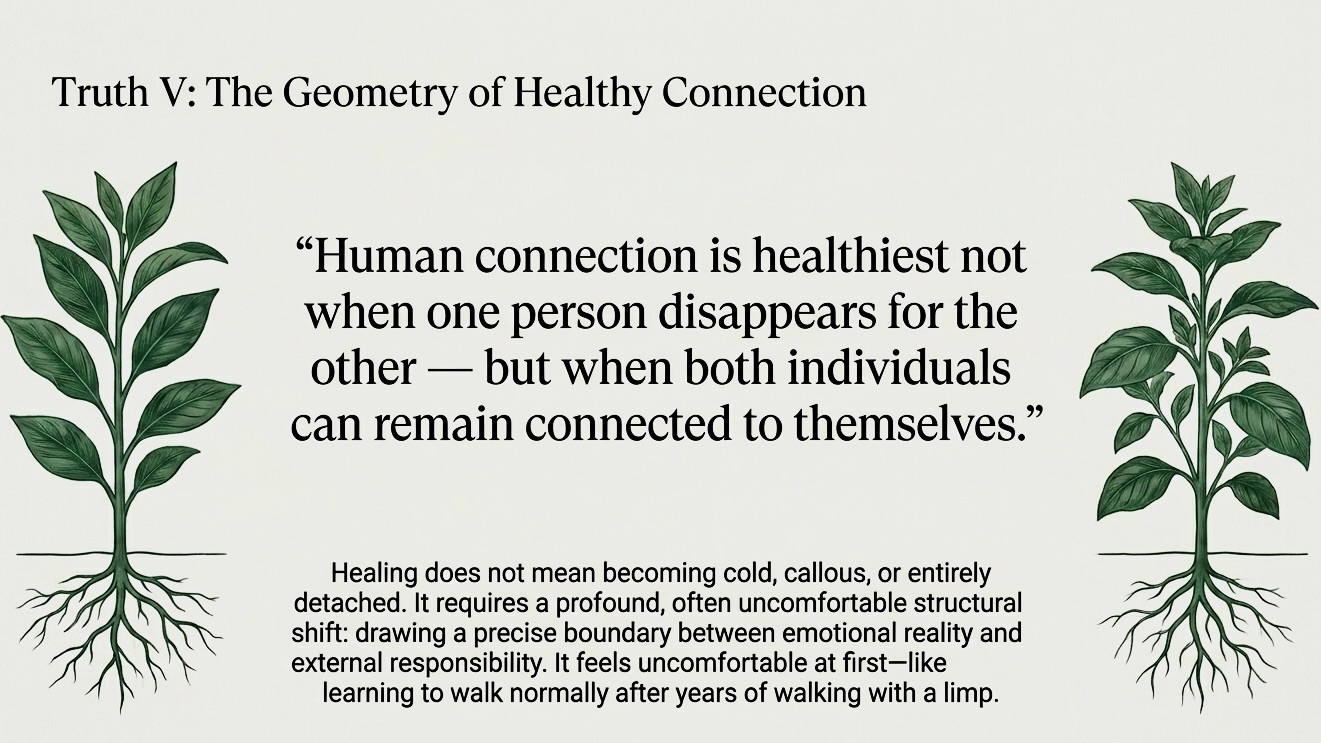
Recovering from codependency doesn't mean becoming selfish, cold, or uncaring. It doesn't mean you have to stop loving or caring for others. It means learning to come back to yourself and realize that your life, needs and dreams are important too!
The starting point for healing from codependency is almost always recognizing your addiction. If you are a codependent, you will very often have some addictive behavior pattern in your life. It doesn't have to be alcohol or another substance. It can be work, helping others, relationships, drama, social media, shopping, eating, or any activity that helps you temporarily distance yourself from how you really feel.
In previous article on addiction, I wrote more about how addictions often become a way to escape feelings that we are unable or unwilling to face. In the case of codependency, addiction often serves the same purpose. It helps to avoid the pain, emptiness, loneliness, shame, fear, or feelings of worthlessness that a person has been carrying around for years.
The longer these patterns persist, the more our inner boundaries begin to dissolve. We learn imperceptibly that our value depends on how necessary, useful, or good we are to others. Thus begins an invisible school of learning to be “enough.” First a sufficient child, then a friend and student, followed by a partner, employee, parent, etc.
However, on the journey of healing, it gradually becomes clear that this “layer of sufficiency” is not actually our true nature. These are protective patterns that have developed over the years that helped us get love, attention or a sense of security in childhood. They were ways to adapt to an environment where directly expressing our true needs did not bring the desired result or did not feel safe enough. - in a word, it is MANIPULATION
Many codependent people love and care deeply. They are loyal and willing to be there for their friends and loved ones even in the most difficult moments. These are undoubtedly valuable qualities.
The challenge, however, is that codependency can wear the mask of love. Therefore, it is not always easy to notice when caring and supporting have inadvertently turned into a responsibility that actually belongs to the other person. Of course, the desire to help, support and care is a natural and necessary quality, but at some point we may discover that in addition to caring, we have also started to solve the other person’s problems, bear their emotions or take on the consequences of their life.
Therefore, it is worth asking yourself from time to time: "Am I supporting or taking responsibility for this person?"
When helping becomes an identity
One of the most important ideas Pia Mellody explores in her book Facing Codependence is that many codependent people gradually lose their sense of where they end and another person begins. As children, they often learned—whether directly or indirectly—that their worth depended on being useful, responsible, adaptable or available to others, most often for their own parents. Some became peacemakers. Others became caregivers and many of us became the strong ones everyone relied upon. Different roles, but often the same underlying identity- the rescuer.
Over time these roles stop being something we do and become someone we believe we are. The challenge is that the rescuer identity always needs someone to rescue.
Carl Jung described the persona as the mask we present to the world—the version of ourselves we believe will be loved, accepted or valued. In codependency, that mask is often the caregiver, the helper, the peacemaker, or the person who is always strong.
Yet there is always another side of us.
As of model of Johari Window- some parts of us are visible both to ourselves and to others. Some are hidden from the world. And some remain hidden even from ourselves. It is often in these hidden places that our unmet needs, fears, loneliness, disappointments, and insecurities reside. These are the parts of ourselves that may never have been given enough safety, space or permission to be fully seen, felt, and understood. At some point in the healing journey a profound realisation begins to emerge:"What if my constant caring for others has also been an attempt to meet needs I never learned to acknowledge within myself?"
For many people, this moment feels like an awakening.
Not because everything suddenly changes, but because they begin seeing their patterns more clearly. They start recognising the difference between who they truly are and who they learned to become in order to feel loved, safe or accepted.
This is often where real healing begins and therapy sessions can become most uncomfortable. A period of deep self-reflection follows. Parts of ourselves that have remained hidden for years gradually come into awareness. We begin noticing our genuine needs, desires and boundaries. We learn to say NO before exhaustion, resentment or burnout takes over once again.
But this process comes at a cost.
It often requires us to face loneliness, uncertainty, grief, abandoned dreams and the exhaustion we have been carrying for far longer than we would like to admit. Many people consider leaving therapy at this stage because it can feel as if they are getting worse instead of better. Yet in reality, this discomfort is often a sign that something important is shifting. The old survival strategies are beginning to loosen their grip, which brings us to an important question: "Where is the line between love and rescuing?"
The simplest answer to that question is: "Healthy love supports growth but rescuing seeks relief."
When we care and love someone, we can stand beside them during difficult times. We listen, encourage and support them when needed. At the same time allowing them to remain responsible for their own life. Allowing them to make choices and experience the consequences of those choices. After all, growth happens through experience, mistakes and learning.
Rescuing may look similar from the outside, but the motivation underneath is very different. Rescuing happens when another person's discomfort becomes so difficult to tolerate that we feel compelled to make it disappear. Without realising that one's begin living their life more than it's own.
In everyday life it might look like:
A partner becomes upset, and we immediately start fixing, solving, or managing their emotions.
An adult child makes poor decisions, and we rush in to soften the consequences.
A friend repeatedly faces financial difficulties, and we feel obligated to rescue them once again.
A colleague avoids responsibility and uses praise, guilt, or manipulation to get us to do their work.
Over time, this becomes exhausting. Eventually, many rescuers find themselves asking: "Why does nobody take care of me the way I take care of everyone else?"
The answer is often painful. Rescuing does not create healthy relationships- It keeps both people stuck. One remains dependent and the other remains responsible. Nether them are truly free to grow.
Taking back the inner power – a period called narcissism...
If in the previous phase, priorities have begun to become visible and we have somewhat learned to notice and value them, then at some point the healing journey reaches the next stage. There comes a time when we must start standing up for these new priorities, needs and previously hidden parts, protecting what is real and destroying what is not...what no longer serves us... Old roles, beliefs and patterns of adaptation gradually begin to lose their influence and something more authentic emerges in their place.
This is where what could be called the narcissistic period often appears. In recent years, the word “narcissism” has become very popular on social media. Sometimes it even seems that most men are narcissists and women are their victims.
However, the reality is much more diverse. In the context of recovery, we are not talking about pathological narcissism, but about a developmental stage that several psychologists, including Heinz Kohut, have described as a necessary part of the formation of healthy self-worth.
This is a time when one learns, perhaps for the first time to take one’s needs seriously. - To say NO, to protect one’s energy, to give up constant adaptation and to choose oneself without guilt!
From the outside, this change may seem unexpected or even unsettling to those around you. People who have become used to your endless availability, helpfulness, or self-sacrifice may say that you have changed—and not for the better. They may describe you as selfish, cold, or difficult.
The truth is that you may not have become more selfish at all.
You may simply have become more visible. And sometimes, when someone begins to shine more authentically, that light can be difficult for others to adjust to.
The energy of healthy narcissism helps you stay on your own side during this very vulnerable phase. It helps create boundaries and sometimes temporary defenses so that you don’t fall back into old patterns and lose yourself again. This is an important stage of integration and transition and it is also during this phase that you need to rebuild the foundation on which a healthy sense of self can rest.
Many of the foundations introduced above were not sufficiently developed in childhood or were not formed at all. This is precisely why healing from codependency cannot happen as a result of a few therapy sessions or a quick insight.
It is important understand that the goal of therapy is not to "fix and do the work" for the client . Therapy helps to notice and become aware of those blind spots where development has blocked and where necessary skills have not been learned. The real work begins after leaving the therapy room - in real life situations, relationships, conflicts and challenges. It is there that we gradually learn to manage our emotional regulation with greater awareness, so that our lives are no longer shaped by unconscious reactions, but by conscious choices aligned with who we truly are.
In her book Codependence, Pia Mellody explains that healing often involves reclaiming five fundamental rights that every child is born with, but which may become damaged or fail to fully develop when growing up in a dysfunctional environment.
These five rights form the foundation of healthy self-worth and emotional maturity.
The right to be valuable
Which means that your value doesn't depend on how much you care for others, how much you achieve or how well you meet other people's expectations. You have the right to be valuable simply because you exist. Even if you don't have anything to prove or give to anyone at the moment.
The right to be vulnerable
Which means you don't have to carry and hide everything all at once. You have the right to feel sadness, fear, disappointment or insecurity and to express those feelings. You have the right to say, "I can't handle it right now," without feeling ashamed or weak.
The right to be imperfect
Which means letting go of the endless pursuit of being the perfect partner, parent, employee, or any other role you may play in life. You have the right to make mistakes, to forget, to fail and to learn from your experiences. Not as an excuse to give up, but as an invitation to live a more authentic and fulfilling life—one that includes space for joy, rest, and enjoyment, rather than a constant struggle to achieve perfection.
The right to have needs and desires
Which means recognising that your needs, wishes, and dreams are just as important as anyone else's. You have the right to seek rest, support, connection, appreciation or change when your life calls for it. You do not have to continually sacrifice your own needs to meet those of others nor should you expect them to be fulfilled without being expressed. You have the right to speak honestly about what you feel, need and desire, rather than shaping yourself around what seems acceptable, expected or convenient for others.
The right to develop and learn
which means accepting that you do not need to have everything figured out. You have the right to be a work in progress. The right to experiment, to fail, to learn, to reconsider, and to start over. Life is not a test of perfection but a journey of becoming. Through it, we gradually come to know ourselves more deeply, understand the world more fully, and embrace the reality that we are human—imperfect beings who continue to learn, grow, and evolve throughout our entire lives.
The stronger these above five pillars become, the less we need approval, rescue or external validation to confirm our worth. Over time, we begin to discover that our value has never come from outside of us. It has always been there. What was missing was the understanding that our worth is inherent—not something to be earned through achievement, sacrifice, or the approval of others, but something we were born with. From this foundation, we can begin to create a life that is no longer driven by seeking, but by conscious and authentic choices.
Through Fear and Out the Other Side
One of the biggest fears in healing from codependency is not the change itself. More often, it is the fear of losing the identity around which we have built so much of our lives.
If you have spent years being the caregiver, the rescuer, the strong one, or the person everyone turns to, you are not only letting go of a behaviour. You are letting go of a version of yourself.
That is why setting boundaries, expressing needs, or accepting support can feel so uncomfortable. These actions challenge not only what you do, but also who you believe yourself to be.
Healing is not the absence of fear. More often, it is the willingness to move forward despite it.
Step by step, you begin to discover that you do not lose yourself when you stop rescuing others. Quite the opposite. For the first time, you have the opportunity to meet yourself without the filters of roles, responsibilities, and expectations.
As the need to rescue begins to fade, so do many of the subtle forms of manipulation that often accompany codependency. Not only the ways others may have influenced you, but also the unconscious ways you learned to earn love, approval, or attention.
You learn to support without carrying. To care without controlling. To give without depleting yourself and to receive without guilt. You learn to stay present without taking responsibility for what was never yours to solve.
At first, this can feel deeply uncomfortable. Anger, grief, guilt, shame, and loneliness may rise to the surface. Yet at the same time, something else begins to happen. For the first time, you may start noticing just how much your body has been carrying for years. How much energy has been spent adapting, managing, worrying, fixing, and holding everything together.
For me, learning to receive has been one of the most challenging parts of this journey.
Even today, I occasionally notice old patterns resurfacing. At times, receiving money for my work can still feel uncomfortable. Yet I understand that receiving is a natural part of a healthy exchange. When I share my time, knowledge, experience and energy in a way that creates value for another person, it is natural that something is received in return. This is not exploitation, nor is it something that must be earned through sacrifice. It is simply a balanced exchange between two adults.
It has become clear that giving and receiving are two expressions of the same flow. When one is damaged, the other cannot move freely either.
A healthy relationship with love, support and also money requires the capacity to do both—to give openly and to receive without shame, guilt or obligation.
One principle I often remind myself is this: "The giver must set the boundaries, because the receiver often will not."
Not because the receiver is selfish or malicious, but because human beings naturally adapt to what is available. If we continually give more than we truly have to give, we cannot expect others to know where our limits are. The responsibility for protecting our time, energy, and resources ultimately belongs to us.
Might be that one of the greatest signs of emotional maturity is the ability to give generously but not beyond our capacity. It is there that giving and receiving can find their natural balance.
Many people discover that this stage of healing brings a deeper realisation- You are more than your thoughts, emotions or physical body. These are important aspects of who you are, but they do not define the totality of your being. Thoughts change. Emotions change. Behavioural patterns change. And as these changes deepen, life itself begins to change—from the inside out. Sometimes even physical symptoms begin to soften as the nervous system finds a new level of safety and balance.
It is often at this stage that the deeper meaning of spirituality begins to reveal itself. Spirituality, at its heart is one of humanity's oldest questions: "Who am I beneath all the roles, achievements, fears and identities?"
People struggling with codependency, the search for wholeness has been directed outward—toward relationships, recognition, achievement, approval or being needed by others. As attention gradually returns inward, a different experience begins to emerge. The need to control gives way to trust. External validation is slowly replaced by inner knowing. A quiet sense of guidance begins to develop—a feeling for what is true, aligned and authentic for you.
Over time, it becomes clear that no person, relationship nor achievement can permanently fill the space we have been trying to fill from the outside. And maybe this is where healing becomes something more than recovery. A return to the deeper part of us that has always been present beneath the roles, the fears and the survival strategies.
And from that place comes a profound realisation- Sometimes the greatest act of love is not stepping in, but stepping back. Not rescuing, but trusting. Trusting that the other person is capable of discovering their own strength, their own wisdom and their own path.
From Survival to Conscious Choice
Perhaps the most important insight from this article is that healing from codependency does not mean loving others less—it means finally including yourself within that circle of love.
When we stop rescuing, we do not become selfish or uncaring. Quite the opposite. For the first time, we create relationships built on honesty, responsibility, freedom and mutual respect. We stop carrying burdens that were never ours to carry and begin trusting both others and ourselves in a deeper way.
This is where a different kind of strength begins to emerge. Not the power to control people or circumstances, but the ability to stay connected to yourself. The courage to make choices based on your values rather than your fears. The freedom to say YES to what truly supports your life and NO to what pulls you away from yourself.
And while this may seem like a deeply personal journey, its impact rarely ends with one person. Every individual who heals changes something in their relationships, their family and the lives they touch. The effects often travel much further than they can see.
Which raises an intriguing questions:
"What if healing is never only personal?"
"What if every choice we make—toward awareness, responsibility and self-compassion—creates ripples far beyond our own lives?"
and
"what if the transformation of the whole, begins with the transformation of the individual?
These are some of the questions we will explore in the sixth and final article of this series about codependency...
"Life is a potential and you are it's expression"
Kristel Kesalo
Bioenergeticist- Holistic Integration therapist
SunsetRise OÜ
Kuidas see artikkel sind puudutab?
Kommentaarid

Kristel Kesalo
Bioenergeetik – Holistilise integratsiooni terapeut
Toetan bioenergeetiku ja integratsiooniterapeudina Sind sisemise selguse ja tasakaalu leidmisel olukordades, kus: 1. oled jõudnud kriisiseisundisse – koged ärevust, läbipõlemist, väljakutseid paarisuhetes või peresuhetes, sõltuvusmustreid või muutusi erinevates eluvaldkondades, või 2. oled teinud teadliku otsuse muutuseks ühes eluvaldkonnas... Ma toetan Sind protsessis, kus väline segadus hakkab lahti hargnema läbi sisemise kontakti (eristad mõtteid, emotsioone ja tunnetad keha) kus keha, meel ja teadlikkus saavutavad koostöö. Selle tulemusena hakkab Sinus loomulikult tugevnema: Sisemine turvatunne –närvisüsteem rahuneb, väheneb ülekoormus ja sisemine pinge- tekib sügavam stabiilsus ja kohalolu Selgus – mõistad, mis on tegelik takistus, mis on harjumuslik muster ja missugune on Sinu tegelik vajadus. Enesejuhtimine – suudad reguleerida oma emotsionaalseid reaktsioone ja teha teadlikumaid valikuid. Piirid ja suhted – lood tervemaid suhteid, väljendades oma vajadusi selgelt ja tasakaalukalt.