
You don't see in your partner what you're hiding in yourself
From the series "What's really going on in your relationship" · 7/9
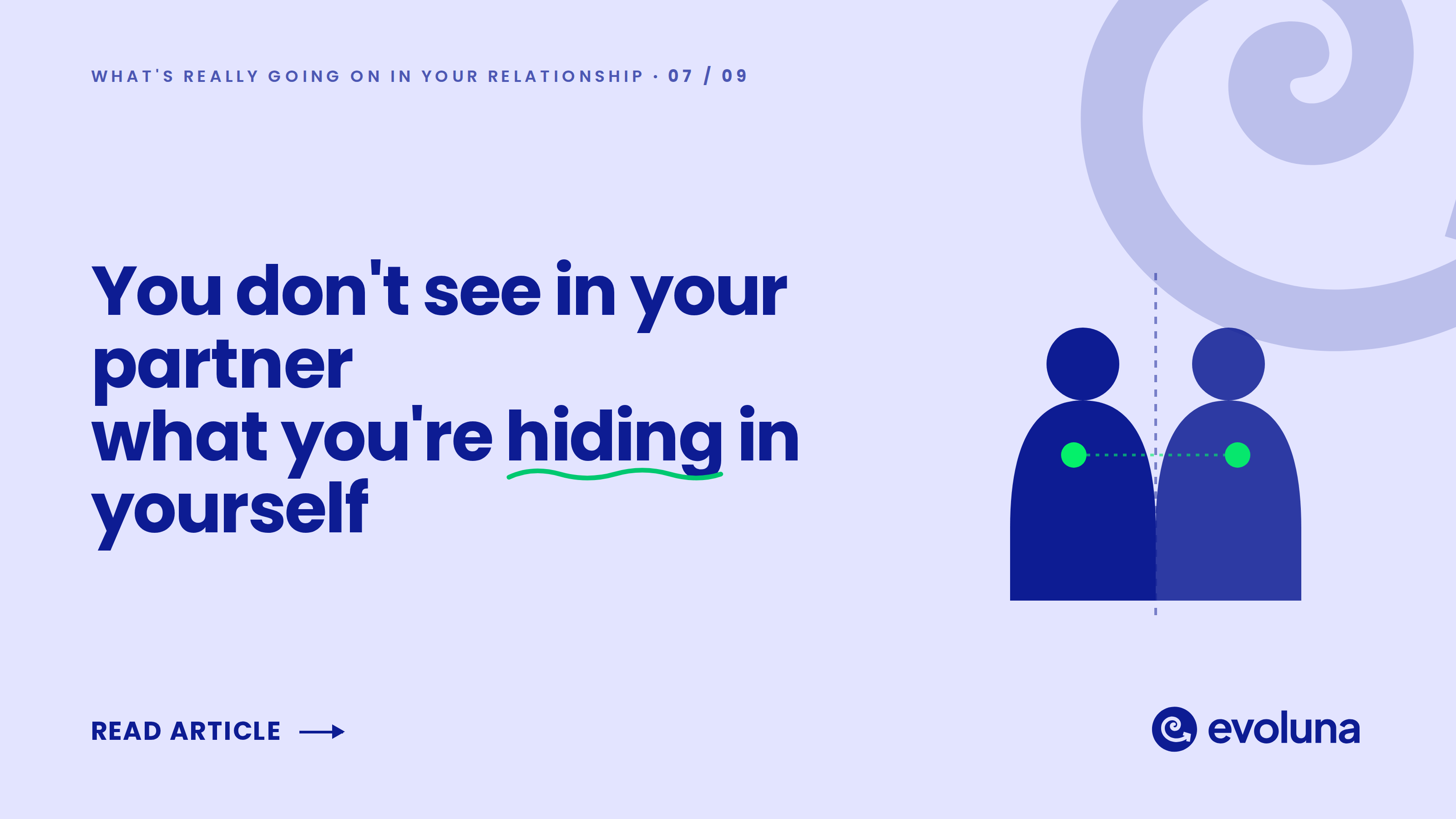
There's a very uncomfortable observation in relationships.
The things that irritate you most about your partner are often connected to something it's hardest for you to see in yourself.
The woman says: "He's so controlling. He has to decide every little thing."
But when the conversation turns to her own life, you can see that she's also a decider. She also carries. She also keeps a lot of things under control, because deep down she's afraid of what will happen if she doesn't.
The topic of control is actually in both their lives.
But she only sees it in him.
The man says: "She's too emotional. You can't have a calm conversation with her."
But when the conversation turns to his own feelings, he closes up. He doesn't know what to say. He can't name his fear, his sadness, or his insecurity. He only feels discomfort and wants the conversation to end.
The topic of emotion is actually in both their lives.
But he only sees it in her.
This isn't strange.
It's just one of the ways the human psyche protects itself.
Things that are hard for us to look at in ourselves we often see most sharply in other people. Especially in those who are close to us. Especially in our partner.
Because your partner isn't only the person next to you.
Your partner is also a mirror.
And a mirror is uncomfortably accurate for this kind of work.
What is projection
In psychology, this phenomenon is called projection.
Projection means that a quality, a feeling, a need, or an inner conflict that a person doesn't fully want to see or can't see in themselves moves outside. They start to see it mainly in another person.
It usually isn't conscious. Nobody wakes up in the morning thinking, today I'll project my hidden fear onto my partner.
It happens automatically.
Every person does it to some degree. Especially in a long relationship, where the partner is in front of your eyes every day and their behavior touches you more deeply than a stranger's behavior ever could.
A classic example is someone who has given too much in their life, suppressed their own needs, and "managed" even when they actually needed help. When their partner expresses a need directly, it can trigger a strong irritation in them.
"Why can't she just manage, like I do?"
On the surface it looks like they're irritated by their partner's neediness.
Underneath, there can be something else.
A sad envy.
Not a bad envy. Not a wanting to take something away from the other. A painful recognition: why can't I express my need that openly? Why did I have to learn that a strong person doesn't need? Why is she allowed to ask, but I'm not?
In that case, the irritation isn't only directed at the partner.
It's directed at the suppressed part of themselves that hasn't yet found a way to become visible.
Why it's hard to see yourself
The reason we don't always see ourselves is simple and at the same time deep.
A lot of the qualities we hide in ourselves were brought along from childhood or from earlier relationships. A child learns very quickly what they have to be like in order not to lose love, attention, or safety.
Some learned that they're valuable when they're strong.
Some learned that they're valuable when they don't need anyone.
Some learned that they're valuable when they're good, cheerful, and convenient for others.
Some learned that anger is dangerous.
Some learned that sadness is weakness.
Some learned that too much desire, too much need, or too much voice makes them a burden to others.
These lessons don't just stay as thoughts. They go into the body. They become automatic boundaries around what a person is allowed to see in themselves and what they aren't.
Everything that didn't fit the picture of a "good," "strong," "lovable" or "normal" person doesn't disappear.
It gets hidden.
But the hidden part doesn't go away.
It waits.
And when someone close to you lives out something you've forbidden in yourself, your reaction can be much stronger than the situation itself would call for.
A strong reaction to a quality in another person is often a sign that this quality is touching something in you too.
Not always.
But often enough that it's worth looking at.
How this shows up in a relationship
Let's look at some common patterns of how projection can show up in a couple.
The first pattern is an accusation that doesn't want to resolve.
One partner says: "You're so cold. You don't feel anything."
The other answers: "I try to talk to you, but every time I open up about something, it turns into an accusation."
The first one doesn't agree. To them, the other is still cold, closed, and emotionless.
An accusation like that can repeat for years.
Sometimes the partner really is emotionally unavailable. That can't be ruled out. But sometimes the accuser sees something in the other person they don't notice in themselves. Maybe they're also unavailable to certain emotions. Maybe they can express pain, but not fear. Maybe they can talk about disappointment, but not about their own need. Maybe their own emotional life is also limited, just in a different place.
When that isn't seen, the whole topic stays the partner's "fault."
And then nothing moves.
The second pattern is blame that doesn't fully belong to you.
Your partner blames you for something you don't feel you did. You try to explain, but it doesn't help. They stay convinced. Over time you start doubting yourself: maybe I really was cold? Maybe I really didn't care? Maybe I'm remembering it wrong?
This is a tricky place, because sometimes there's a kernel of truth in the accusation. Maybe you really were tired. Maybe you really weren't fully present.
But the entire blame put on you may not belong to you.
The partner may have touched their own old feeling: fear of not being seen; shame about needing too much; the experience of their feeling staying alone. If they don't see that this feeling comes partly from their own history, they may put the whole weight on you.
Then you're not just talking about today's situation anymore.
You're talking about their old wound through you.
The third pattern is praise that feels aimed at the wrong person.
The partner says: "You're so calm. You handle everything."
On the surface, it's a compliment.
But inside you feel tired, tense, insecure, and almost at the breaking point. You don't feel seen. You feel a role has been put on you: you are the one who holds it all together.
Sometimes praise is just an expression of love.
But sometimes even praise can be projection.
The partner sees in you a quality they themselves long for, or whose presence they need. If you're "calm," they don't have to deal with their own anxiety. If you're "strong," they don't have to notice that you also need support. If you "handle everything," they can keep believing that everything is fine.
That way, even a positive label can become a cage.
The fourth pattern is a wish to change the other person that can never really be satisfied.
One partner wants the other to change.
Be more open. Be less sensitive. Be more confident. Be less quiet. Be more present. Be less controlling. Be more spontaneous. Be calmer.
The other might try. They might make small changes, try to listen, try to behave differently.
But it's never enough.
Because sometimes the first partner doesn't actually want only the other one to change. They want their own inner tension, which gets activated by the other's behavior, to change.
The partner can't fully fix that.
A person can only see that themselves.
What my wife and I have learned alongside five children
One thing my wife and I have learned alongside five children is that every strong reaction doesn't only speak about the other person.
Sometimes it speaks about me too.
Not always. The partner's behavior can be a real problem. Sometimes you have to say directly that this doesn't work, this hurt, this needs to change.
But when the reaction is disproportionate, it's worth pausing.
When my stomach pulls in tighter than the situation would seem to call for. When one small remark stays with me for three days. When I think about something he or she said over and over in the evening. When my reaction is much bigger than the fact itself.
Then there's often something inside me that needs attention.
In our life there have been places like this many times. For instance, in moments when one of us feels the other one is doing "too much" or "too little." On the surface, it's a discussion about workload. Underneath, there can be something else: am I enough? Am I giving enough? Am I being seen? Am I carrying alone again? Do I even let myself rest?
In a moment like that, it's easier to look at your partner and say: you are the problem.
It's much harder to ask: what did this touch in me?
But that's exactly the question that turns a relationship into a place where you can grow.
I've had to ask myself again and again: is the thing that irritates me about her something I don't let myself do? Am I angry about what she's doing, or am I angry because she's allowing herself something I've shut down in myself? Am I accusing her of a quality I don't want to see in me?
These aren't comfortable questions.
But when both partners learn to ask them, the relationship becomes a place where you're not only together.
You can also grow there.
The power of this knowing
Seeing projection doesn't mean you stop seeing your partner's real behavior.
That's important.
Sometimes the partner really does hurt you. Sometimes they really do control, avoid, go silent, attack, or refuse responsibility. Talking about projection should never become a way of silencing a real problem.
But even then, this awareness helps to clean the conversation.
If you go into a conversation with only the sentence "you are like this," the other person will almost always go into defense. They'll start justifying themselves, counter-accusing, or pulling away.
If you go into the conversation while also being aware of your own reaction, the space becomes different.
You no longer say only: "You are controlling."
You can say: "When you make decisions for me, something in me goes into a lot of tension. I know part of this is my own old theme around control and trust, but this situation touched me strongly. I want to talk about it."
That doesn't take responsibility away from your partner.
But it takes some of the attack out of the conversation.
And where the attack lessens, contact can start coming back.
How to notice projection
One. Look at the strength of the reaction, not only at the fact.
When you react very strongly to something that looks small from the outside, there's probably more information there than just the situation itself.
Your partner's silence triggers panic. A small comment irritates you for a week. A friend being late makes you disproportionately sad. One look knocks you out.
These are signals.
Not to blame yourself.
To examine yourself.
Two. Ask: do I feel this quality inside myself too?
If your partner seems controlling, ask: where do I control? If your partner seems passive, ask: where do I drop responsibility? If your partner seems too sensitive, ask: where am I afraid of my own sensitivity?
The answer is often yes.
But the place is different.
Three. Ask: do I hate this quality in myself?
If yes, projection is very likely.
Sometimes a partner's quality irritates us not because it's so foreign, but because it's too familiar. We just don't want to see it in ourselves.
Seeing this is uncomfortable.
But it's also freeing.
Four. Talk about it through yourself, not only through them.
For example:
"I've realized that what bothers me about you is when you make decisions alone. But I see that I do this too. I don't want to make it only your problem. At the same time, I do want to talk about how we hold decisions together better."
A sentence like that doesn't lessen the seriousness of the topic.
But it creates the possibility that you don't end up standing against each other.
You stand together in front of a pattern.
Five. Give this skill time.
Noticing projection doesn't turn you into a clear-seer overnight. It's a habit. At first you notice only after the fight. Then in the middle of the conversation. Eventually, maybe even before the accusation comes out of your mouth.
It's slow work.
But it changes a relationship deeply.
The relationship as a mirror
In the end, this is all about one thing.
A relationship isn't only a place where two people live, raise children, share a home and carry the everyday.
It's also a place where two people see themselves in a way that would be very hard to see alone.
Your partner shows you something about yourself every day. Not always directly. Often through the reaction you have to them. Through the topics that come back to the surface again and again. Through accusations you make. Through accusations made to you. Through what disproportionately hurts, irritates or pulls you.
Every moment like this is information.
Not only information about how to change your partner.
But information about what you still don't see about yourself.
A person willing to take in that kind of information can grow in a relationship in ways that are hard to reach alone. Because the mirror is there every day. Uncomfortable, close, and more honest than we often want.
A person who doesn't want to see this often changes partners, but ends up meeting the same theme again.
Not because "all men are like this" or "all women are like this."
But because the theme wasn't born only from the other person.
It was born from them too.
A relationship doesn't only show you who the other one is.
A relationship also shows you who you are.
If you dare to look.
Pert Lomp is the founder of Evoluna, a graduate of the Fontes leadership mentoring programme, and an EMCC certified mentor.
From the series "What's really going on in your relationship":
- 6/9 → Trust isn't always broken by a big betrayal. Often it's the small, quiet withdrawals that break it.
- 7/9 → You don't see in your partner what you're hiding in yourself. (this article)
- 8/9 → Children don't create a relationship. They reveal what it really is.
If these words touched you, start with the Evoluna self-discovery assessment. It doesn't diagnose, it reflects. → evoluna.app
Pert Lomp is the founder of Evoluna, a graduate of the Fontes leadership mentoring programme, and an EMCC certified mentor.
From the series "What's really going on in your relationship":
6/9 → Trust isn't always broken by a big betrayal
7/9 → You don't see in your partner what you're hiding in yourself (this article)
8/9 → Children don't create a relationship. They reveal what it really is
If these words touched you, start with the Evoluna self-discovery assessment. It doesn't diagnose, it reflects. Start your journey →
Kuidas see artikkel sind puudutab?
Kommentaarid

Pert Lomp
Strateegiline mentor ja süsteemide looja
Olen strateegiline mõtleja ja süsteemide looja, kes aitab inimestel ja organisatsioonidel liikuda kaosest selguse, struktuuri ja tulemuste suunas. Minu tugevus seisneb võimes näha suurt pilti ning siduda omavahel tehnoloogia, finantsid ja juhtimine tervikuks, mis päriselt töötab. Mul on üle 25 aasta kogemust erinevates rollides – alates tehnoloogia ja meedia valdkonnast kuni juhtimise, äriarenduse ja strateegilise nõustamiseni. Tegutsen täna eelkõige mentorina ja partnerina inimestele, kes on jõudnud punkti, kus järgmine samm ei vaja enam rohkem infot, vaid selgust, otsust ja suunda. Mind käivitab kasv – nii inimeste kui süsteemide tasandil. Usun, et enamik piiranguid ei tule väljastpoolt, vaid meie enda mõtteviisist, harjumustest ja uskumustest. Minu roll on aidata need mustrid nähtavaks teha, need lahti murda ning asendada need toimivate, teadlike valikutega. Minu lähenemine on kombinatsioon ratsionaalsest strateegiast ja sügavamast inimlikust mõistmisest. Töötan seal, kus kohtuvad loogika ja sisemine areng – kus otsused ei ole ainult õiged Excelis, vaid ka kooskõlas inimese tegeliku potentsiaali ja suunaga. Mentorina olen otsekohene, kohal ja tulemustele suunatud. Ma ei paku pehmendatud vastuseid, vaid selgust. Samas loon ruumi, kus inimene saab turvaliselt mõelda, näha ja kasvada. Minu jaoks on kõige suurem väärtus hetk, kus inimese sees tekib “klõps” – kui segadus asendub arusaamisega ja ebakindlus muutub teadlikuks liikumiseks edasi. Kui oled punktis, kus tead, et oled võimeline enamaks, aga vajad selgust, struktuuri ja tuge järgmise sammu tegemiseks, siis siin me kohtume.